
Stage 1 Tower of London to the Bank of England
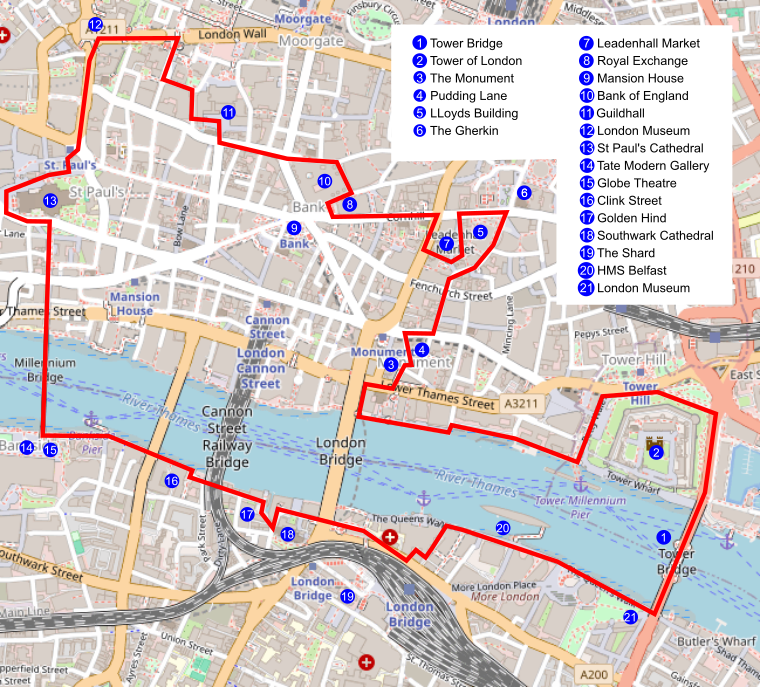
This walk is circular; therefore, you can begin at any point you like. We’ve decided to kick things off at Tower Hill Underground Station, right across from the Tower of London. Consequently, this makes a great starting point if you want to explore the area in the morning. Much of this walk is within the old City of London, the original conurbation when it had a city wall.
These guides focus on the practical aspects of the walk and do not aim to replace a comprehensive guidebook for London. With a reliable London street map or a mapping app on your phone, you’ll easily navigate this route and feel free to make interesting detours and adjustments along the way.
This page splits the walk over three pages. While this page covers Tower of London to the Bank of England, two other pages cover: Stage 2 Bank to St Paul’s Cathedral and Stage 3 St Paul’s to Tower Hill
City of London Walk map
Starting from Tower Hill
Simply follow the signs over to the Tower of London, descending on the western side of the Tower to the main entrance. Additionally, well maintained public toilets can be located here too.
Visit our Tower of London and Tower Bridge page for more information.
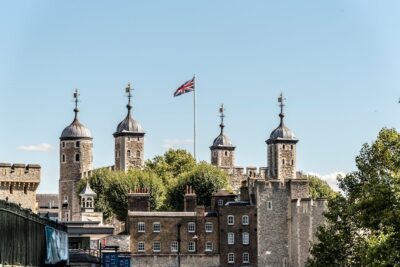
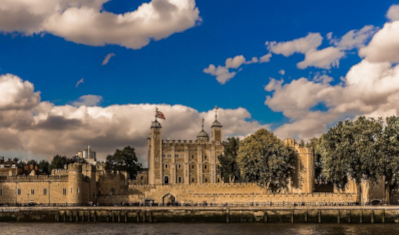
The Tower of London
The Tower of London stands at the south-eastern corner of the city wall, where it meets the river that defines London’s southern edge. Strategically constructed, this historic fortress aimed to protect the city from potential threats, particularly those that might arrive via the River Thames from the sea.
The Romans, about 2,000 years ago were the first to establish London as a city as we would know it today. As now, they built London then on trading and commerce.
As you make your way down to the riverfront, you’ll find the section of the River Thames nestled between Tower Bridge and London Bridge, referred to as the Pool of London. This area served as London’s original port. Back in the day, the river was significantly broader than it is today, and the land across the water was primarily marshy terrain.
London Bridge
London Bridge was the original bridge that forded the River Thames, the first crossing point from the sea. For a long time until 1750, London Bridge was the only bridge across the Thames, partly because of the vested interest opposition of the ferrymen that earned a living plying from bank to bank.
The London Bridge you see today is roughly 30 years old. The City of London sold the original bridge and transported it to Lake Havusa, Arizona, where it became a popular tourist attraction.
If you are not doing the full walk you might want to go and explore Tower Bridge more closely. Tower Bridge is a relative newcomer, only opened in 1894. Otherwise turn away from Tower Bridge and follow the river path of the north bank westwards. Follow the river path until you approach London Bridge.
Visit our blog: The best free way to experience Tower Bridge
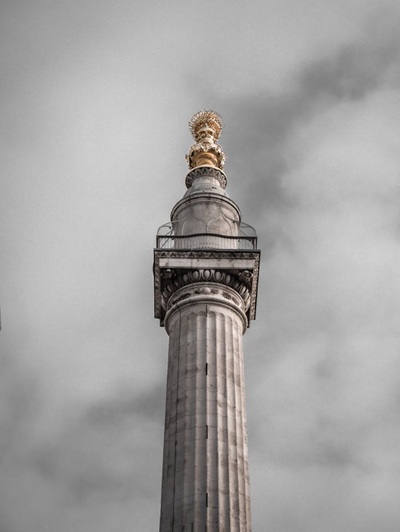
The Monument
Climb 311 steps for fantastic view of London
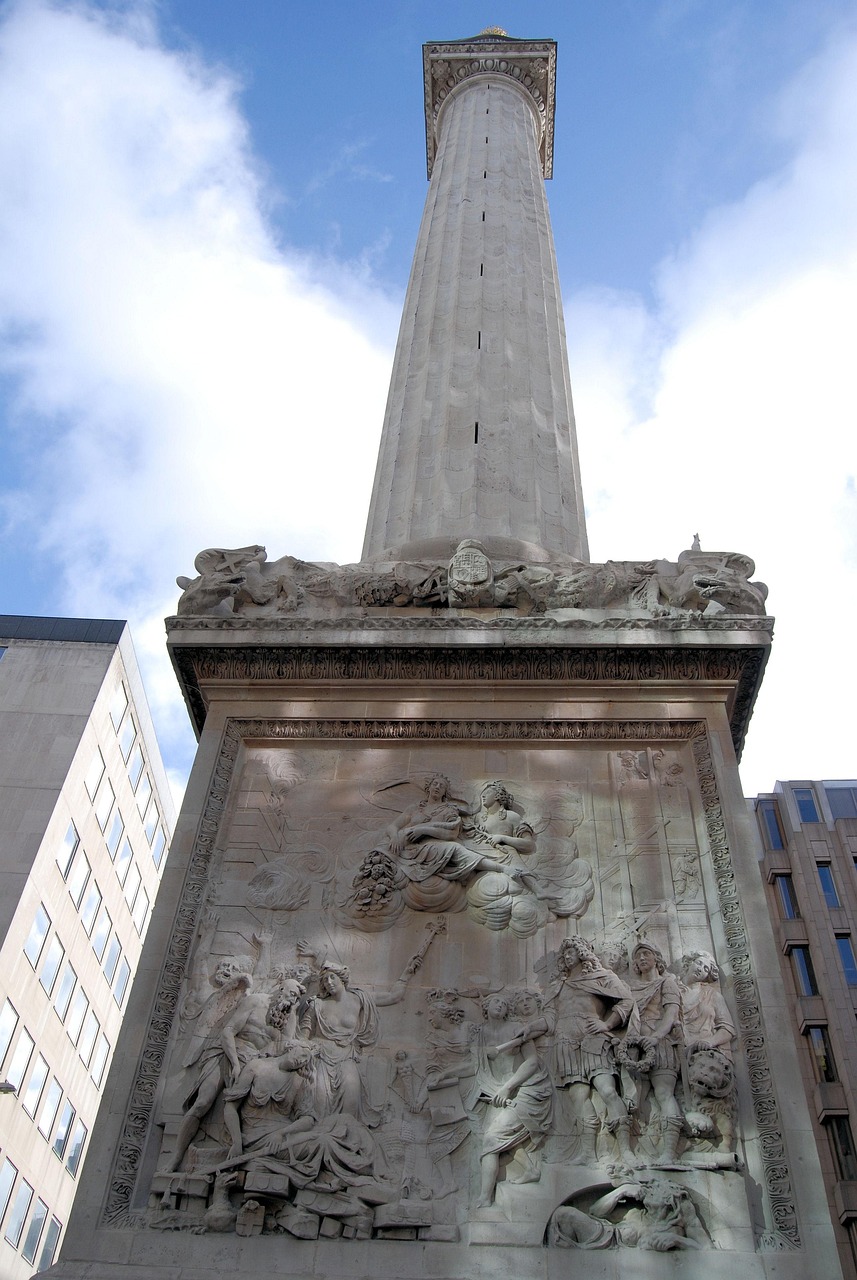
Turn right just before London Bridge. Take care to cross the busy road that parallels the river, then climb up Fish Street Hill on the opposite side of the road. Fish Street Hill is the first road northwards for traffic coming east from Westminster after crossing under London Bridge. Keep to the right-hand side of the road the short way until the road bends left. On this bend to your right is the Monument.
In 1666 there was the Great Fire of London, destroying much of London. The Monument is a memorial to that event, its height 205ft, is the same as the distance to the baker’s shop in neighbouring Pudding Lane where the fire started.
The Monument is the tallest stone column in the world, topped by a vase of flames. Designed by Christopher Wren who also was responsible for St Paul’s Cathedral which we visit later in the walk.
If you’re in good shape, you can buy tickets for a small fee and climb the 311 steps inside the column to enjoy a fantastic view from the top.
Head east (back in the direction of the Tower of London) along Monument Street. In a few yards the first road crossing on Monument Street is Pudding Lane itself. Turn left, up Pudding Lane. The fire that started here destroyed 15,000 homes and 87 churches, much of the city area in 5 days.
Lloyd’s of London
At the top of Pudding Lane, turn right along Eastcheap, then first left up Philpot Lane. In a short while you encounter Fenchurch Street, go straight over. Philpot Lane has become Lime Street.
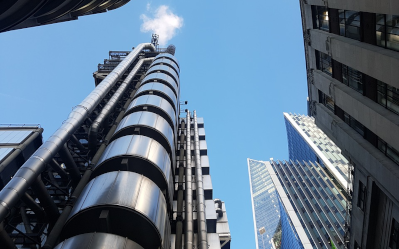
Follow Lime Street as it bends right and then left. The unmistakable Lloyd’s of London building now dominates your attention.
Looking a bit like the Pompidou Centre in Paris, this 1986 building has all its pipes, ducts and lifts on the outside of the building. Originating from a coffee house in the 1860s, Lloyd’s is now the world’s leading insurance market, covering the most complex and specialist risks, from celebrities body parts to oil rigs.
The Gherkin (30 St Mary Axe)
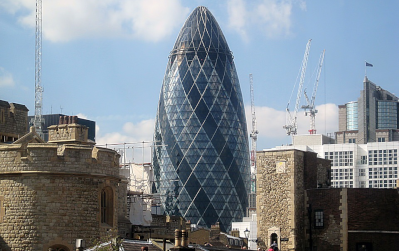
After continuing past the Lloyd’s building, the main road crossing is Leadenhall Street. Almost opposite is St Mary Axe Street. From the corner of St Mary Axe opposite the church you have a grandstand view of the colloquially named Gherkin (for obvious reasons) or 30 St Mary Axe.
The Gherkin was completed in 2004 for Swiss Re, the second largest insurance company in the world. It is now privately owned by several offices and is firmly established as one of the icons of the London skyline. It is not the tallest building, but its 41 floors has captured the imagination of the public.
The Gherkin isn’t normally open to the public but you can visit Helix restaurant and Iris bar, which are located on the top floors and have amazing panoramic views across the City of London.
Now retrace your steps, back along Leadenhall Street and turn left into the next road after the Lloyd’s building, Whittington Avenue.
Leadenhall Market
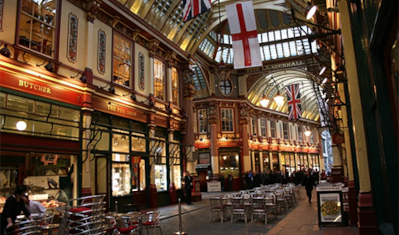
Whittington Avenue leads into the Leadenhall Market complex, a visually very impressive Victorian Market dating from 1881.
The market stands on the site of a Roman basilica. The original market was burnt down in the Fire of London and was then expanded to sell poultry, dairy goods, leather, wool and meat.
It now contains a wide variety of shops and bars. Wander around, a nice place to browse the specialist shops and perhaps take a coffee break.
Make your exit on the western side of the market in Gracechurch Street, the opposite side to your entrance into the market. Turn right up Gracechurch Street to the first main crossroad.
Turn left into Cornhill and follow it for 800m to Bank Underground. Along the way your curiosity will be aroused by the alleys and interesting side lanes. You will be rewarded if you follow your nose down alleys and into churches in a very atmospheric part of London, the oldest. Just return to Cornhill from your adventures.
St Peter upon Churchill Church on the south side of Cornhill is the oldest place of Christian worship in London.
In recent times Leadenhall Market has been used as a filming location for the first Harry Potter film Harry Potter and the Philosopher’s Stone.
If you’re a Harry Potter fan and you want to visit Leadenhall Market on an organised guided walking tour we can thoroughly recommend the award-winning Muggles Walking Tour in London.
This is the end of Stage one of the London City Walk.
For the other stages please see: