RELATED LINKS





 Rome Toolkit
  Paris Toolkit
 London Icons self-guided walk
Stage 2 Horse Guards to London Eye and Westminster
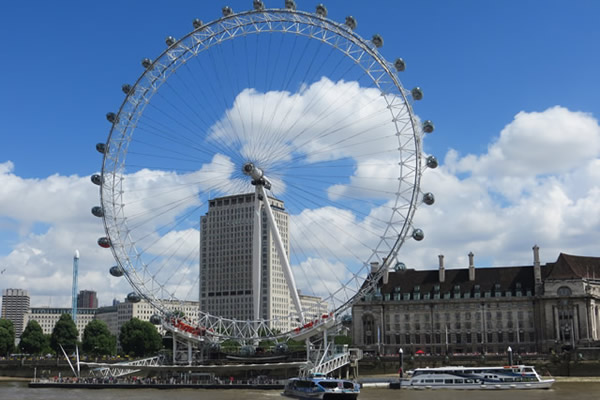
This is the second part of our circular walk that covers many of London's main sights including Big Ben, Westminster Abbey, Buckingham Palace and the London Eye to name just a few.
Stage 1 of the walk begins at Westminster Underground Station.
If you just walked this without stopping you'd do it in under an hour, but as there is so much to see you probably will have done well to complete it in one day.
These notes have focus on the logistics, no attempt is made to be a substitute for a good guide book on London.
With a good London street map or map app on your phone you'll have no problem following this walk and be fully equipped to make interesting diversions and adaptations with confidence.
London Icons Walk map
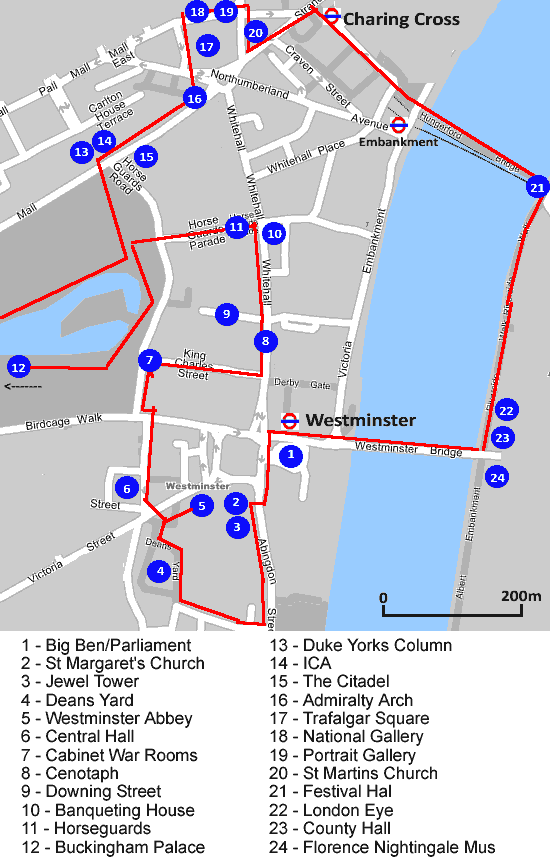
Continuing walk from Stage 1 at Horse Guards
We left the walk in Stage 1 at Horse Guards, this a circular walk, so it doesn't matter really where you start.
We continue our walk by going through the arch away from Whitehall to the parade ground on the other side of Horse Guards. Keep going straight across the parade ground, cross the road into St James's Park.
St James's Park
This was London's first Royal Park created by Henry VIII in 1532 and for many, the nicest of the Royal Parks.
The centrepiece is the lake that attracts many birds.
We suggest you follow the lakeside walk along its southern perimeter.
There is a restaurant at this eastern end by the lakeside. At the western end cross the bridge over the lake and up to Buckingham Palace.
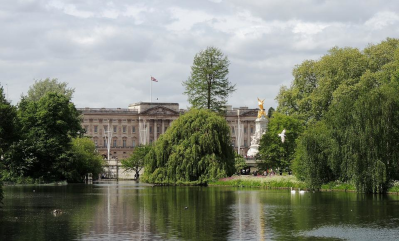
Buckingham Palace
Buckingham Palace has been the London home of the monarchy since 1762. We have a dedicated Buckingham Palace page that also covers the logistics of the Changing of the Guard here.
After Buckingham Palace complete your lap of the lake, this time by following the northern perimeter. A little over half way along the lake take the path veering left, north-eastwards towards Trafalgar Square.
The Mall
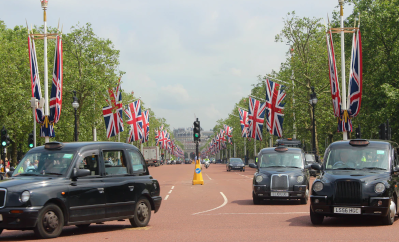
The broad road on the northern perimeter is the Mall. We are heading for the north east corner of St James's Park at the junction of the Mall and Horse Guards Road that is the eastern perimeter road.
At this point on the far side of the Mall is a tall 38m granite column called the Duke of York Column. When the Duke of York died in 1827, the entire British Army had to forego one day's wages in order to pay for a monument to the Duke. The column was started in 1833 and finished one year later.
Just to the right of the column is the Institute of Contemporary Arts (ICA). Exhibits have often caused public outrage in the past. Unlike the National Gallery just round the corner, there is an admission fee.
Opposite the ICA is the Admiralty Citadel. This bunker like windowless building with vegetation covering its walls is part of the Admiralty and was built in the Second World War to withstand a 1,000lb bomb. Underneath the ground you are standing on is a web of underground tunnels connecting government departments, Buckingham Palace and Downing Street.
It is thought there is a branch of the Victoria Line Underground between Green Park and Victoria stations that goes to Buckingham Palace and the Mall could be used as a landing strip if the worst happened.
We follow the Mall to its end, exiting on to Trafalgar Square through Admiralty Arch built as a memorial to Queen Victoria. The building now houses apartments for the government.
Trafalgar Square
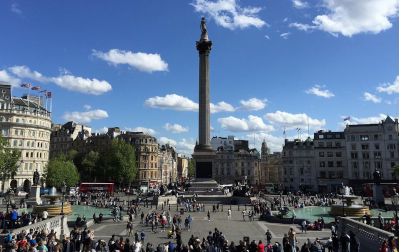
Trafalgar Square today is pretty much a traffic island. In the last few years two sides of Trafalgar Square have been pedestrianised. We suggest that for this walk you first cross into the centre of the square where Nelson's Column is located.
The name commemorates the Battle of Trafalgar (1805), a British naval victory of the Napoleonic Wars. The centrepiece, Nelson's Column is topped by a statue of Horatio Nelson, the admiral who commanded the British Fleet at the battle of Trafalgar.
The square has become a social and political location for visitors and Londoners alike. There are often events put on here, political rallies rally here and its one of the main points to see in the new year too.
Trafalgar Square is also technically the centre of London. If you are travelling around England and see a road sign saying London x miles, it is to Trafalgar Square that this distance is measured to.
The National Gallery
Dominating the northern side of Trafalgar Square is the National Gallery. The National Gallery, London, houses one of the greatest collections of European paintings in the world. The National Gallery houses more than 2,000 European paintings from the 13th century to 1900. Like most of the major art galleries entry is free.
Next door to the National Gallery is the National Portrait Gallery. The Gallery was founded in 1856 to collect portraits of famous British men and women. Explore 120,000 portraits from the 16th century to the present day. Like the National Gallery, entrance is free.
St Martin-in-the Fields Church and cafe
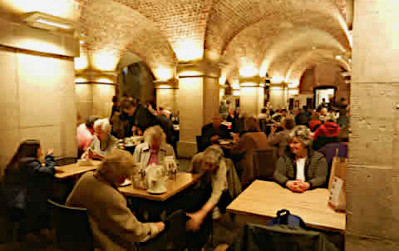
On the eastern side of Trafalgar Square is St Martin-in-the-Fields Church. Because of its prominent position, St Martin-in-the-Fields is one of the most famous non-cathedral churches in London. The church is known for its regular lunchtime and evening concerts and has a popular cafe in its crypt.
Leave Trafalgar Square along Duncannon Street which runs along the south side of St Martins. At the end of Duncannon Street you will see Charing Cross Station directly opposite, the most central of London's railway stations.
Cross over the road and walk down the left hand side of the station, a narrow lane with shops. This will bring you to Embankment Station, follow the signs up to the Golden Jubilee Bridge that you can see above you crossing the River Thames either side of the railway bridge. Cross over the footbridge, you have great views of the River Thames both ways.
Royal Festival Hall
On the south side of the footbridge, to the east is the Royal Festival Hall. The Royal Festival Hall is the only remaining fixture from the 1951 Festival of Britain.
The hall hosts a wide range of the performing arts from classical and modern music to dance and the visual arts.
The London Eye
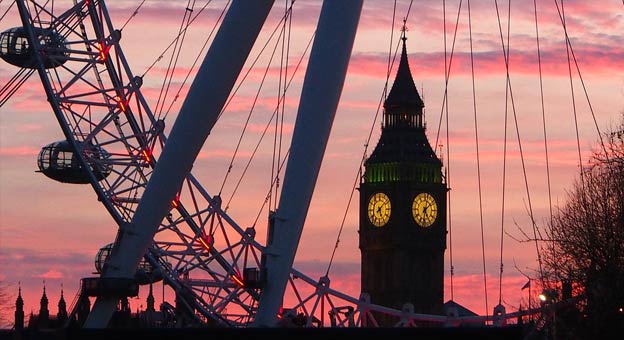
You will have seen the London Eye by the river as soon as you crossed the Golden Jubilee Bridge.
Built for the year 2000 celebrations the London Eye has become one of the most popular attractions for visitors. The wheel and its capsules take 45 minutes to make a rotation giving great views over the city.
We have a dedicated London Eye page.
The pedestrianised area along the river here is popular with street entertainers. The Jubilee Gardens are a welcome spot of green on a hot day to lay out and have an ice cream.
County Hall
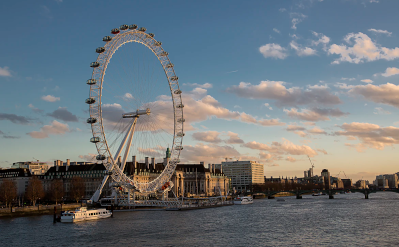
The grand building besides the London Eye, in the background of the picture above is County Hall. County Hall used to be home to the Greater London Council, local government for London until it was abolished in 1986.
Today it houses two hotels, the Marriott and Premier Travel Inn County Hall, two of the best located hotels in London.
Also in the building along the riverfront is an aquarium and a museum devoted to the surrealist painter, Salvador Dali.
County Hall is by Westminster Bridge, where on the opposite side we started the walk. Either climb the stairs up to the bridge and across to the start at Big Ben or walk through the short tunnel under the bridge to the opposite side for good views of Big Ben and the Houses of Parliament.
This is the end of Stage two of the London Icons Walk. If you have completed Stage one you only need to walk back across Westminster Bridge to return back to the Houses of Parliament where you started.
For Stage one please see: Stage 1 Houses of Parliament to Horse Guards via Westminster Abbey
POPULAR LONDON ATTRACTIONS - ADVANCE PURCHASE AND/OR FAST TRACK TICKETS
| London Eye | Amazing panoramic flight on the world's highest observation wheel. » Fast track tickets available. |
| The Shard | Tallest building in Western Europe with viewing of London from the top. » Fast track tickets available. |
| St Paul's Cathedral | Cathedral of the Diocese of London, venue for royal weddings. » Pre-book to guarantee entry. |
| Westminster Abbey | Along with St Paul's, England's main religious building.» Pre-book to guarantee entry. |
| Tower of London | Home of the Crown Jewels and a rich thousand year history. » Fast track tickets available. |
| Madame Tussauds | See wax statues of the most famous people in the world. » Fast track tickets available. |
| London Dungeon | The creepiest attraction in town, the London Dungeon. » Fast track tickets available. |
| Hampton Court Palace | Henry VIII Medieval Palace set in vast grounds. » Pre-book to save money. |
| The London Zoo | World class zoo in the centre of London. » Flexi tickets available. |


