

 Rome Toolkit
  Paris Toolkit
 Canterbury Cathedral
What to expect when visiting Canterbury Cathedral, history and walking tours
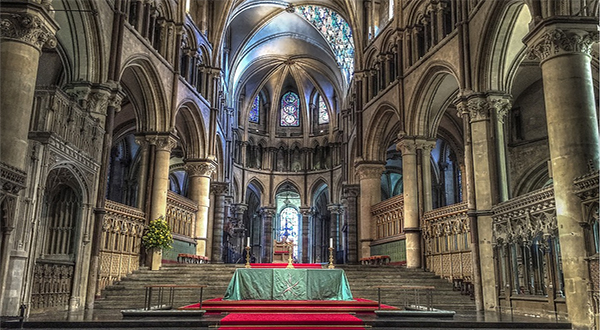
Canterbury Cathedral overview
For perhaps the majority of first time visitors to Canterbury, the big draw is to visit Canterbury Cathedral.
It is the cathedral of the Archbishop of Canterbury, leader of the Church of England and symbolic leader of the world-wide Anglican Communion.
Much of the history of Canterbury Cathedral pre dates the Church of England, notably Thomas à Becket assassinated in 1170 by followers of Henry II, the event that made Canterbury a major place of pilgrimage.
Canterbury Cathedral is at the heart of the city centre, you just turn a corner and all of a sudden the front entrance is in front of you, opposite the tourist office.
Because of the medieval street plan of Canterbury you would have walked a minimum of 5/10 minutes to get to the entrance, even if on a coach tour.
Visiting Canterbury Cathedral
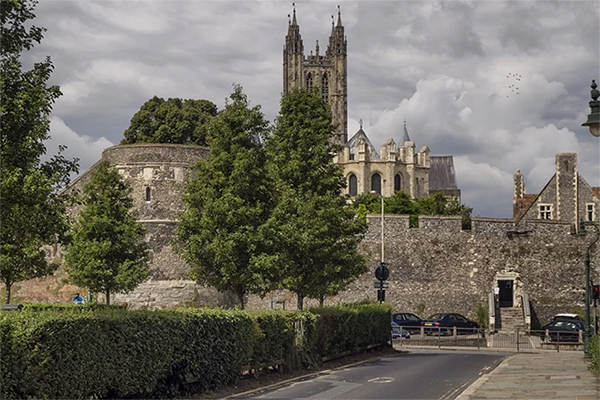
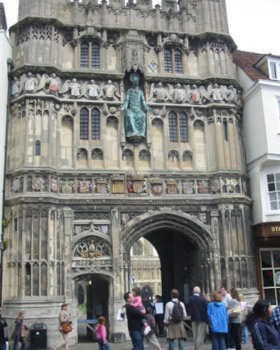
Like Salisbury Cathedral, Canterbury has a well preserved Close, with just a few gates into the religious area from the city streets. You cannot actually see the Cathedral without paying for entry through the main gate.
A work around for this if you do not particularly want to enter the Cathedral is to go on the Canterbury walking tour. The walking tour, is allowed within the Close and the walk spends significant time exploring the Close.
The area within the Close is extensive, the Cathedral is just one part of the complex.
When visiting Canterbury Cathedral, remember this is primarily a working Cathedral not a tourist attraction. At any time there may be a service or perhaps an event or pilgrimage that affects your visit.
Opening hours
The Cathedral is open seven days a week, from 10am to 5pm Monday to Saturday and 12.30pm to 5pm on Sunday. Last admission is at 4pm. It is worth knowing that these times do change at short notice for funerals, weddings, services and exceptional circumstances.
Currently the Cathedral is opening with reduced capacity with pre-booked ticket entry only. There are also no audio guides at present.
Tours
If you are specifically after a guided tour, we would recommend not going on a Sunday as they do not run on this day. Otherwise tours run three times a day.
40 minute audio tours are available all the time in several languages.
It is advised to check the website for upcoming closures and visitor restrictions.
Events
There is a rolling schedule of events, check website for details.
Canterbury Cathedral history
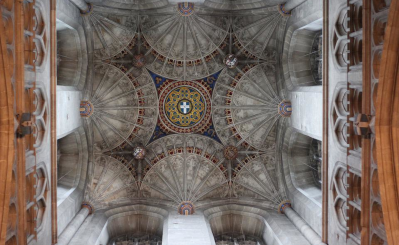
St Augustine
The history of Canterbury dates back to to 597AD when St Augustine was sent as a missionary to establish his seat in Canterbury. The church buildings have been built and expanded since that time with much built in Norman times when the Cathedral was completely rebuilt.
Benedictine Monks
Until the 10th century the Cathedral community lived as the household of the Archbishop. During the 10th century, it became a formal community of Benedictine monks, which continued until the monastery was dissolved by King Henry VIII in 1540 .
Murder of Archbishop Thomas Becket
The best known event in the Cathedral's history was the murder of Archbishop Thomas Becket in 1170. Canterbury, always on the medieval pilgrim route to Rome, became an end in itself, as thousands came to worship at Becket's tomb, especially after his canonization in 1173. Geoffrey Chaucer's pilgrims in his poem, The Canterbury Tales, were by no means unique.
When Becket was made Archbishop of Canterbury by King Henry II in 1162, he changed his total allegiance from the King to the Pope and the Church. Henry had expected his full support, and there were many conflicts between them. Four knights, overheard the King's rage and took seriously his shout of "Who will rid me of this meddlesome priest?" and promptly went to Canterbury and killed Becket at the altar.
Miracles and martyrdom
Three days after his death, there began a series of miracles attached to his martyrdom. These are depicted in the miracle windows of the Trinity Chapel. In 1173, Becket was canonized by Pope Alexander III. Pilgrims began to flock to Thomas' shrine in the Cathedral; a year later Henry, in sackcloth, walking barefoot, was among them.
Civil War period
During the Civil War of the 1640s, the Cathedral suffered damage at the hands of the Puritans; much of the medieval stained glass was smashed and horses were stabled in the nave. After the Restoration in 1660, several years were spent in repairing the building.
Second World War period
During the Second World War, the Precincts were heavily damaged by enemy action and the Cathedral's Library was destroyed.
Guided walking tours of Canterbury
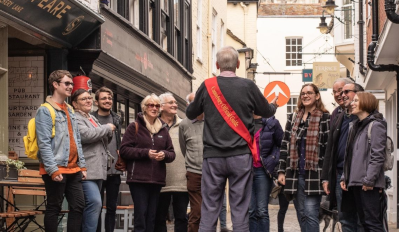
If your visit to Canterbury is for anything other than a quick half day visit to Canterbury Cathedral it is well worth taking a guided walking tour.
The walk will give you a great background to the history of Canterbury from its beginnings to modern day. The walk covers all that is worthwhile in the city centre.
It is a great first item on your agenda, giving you orientation, background and an opportunity to sound out a local guide with no commercial bias of the attractions on offer for you to visit later. You'll hear and see things not in any guide book too.
The walking tour also goes into the cathedral grounds, (though doesn't enter the Cathedral itself) a facet you would otherwise have to pay for. The knowledgeable city guides have been performing this tour uninterrupted since 1948.
Admission charges are very modest and the tour runs daily at 11am and 2pm from in front of the tourist office. During winter months (October to March) only the morning tour operates.
Tickets can be purchased from the official tourist office, directly opposite the front entrance to Canterbury Cathedral.
Canterbury Walking Tour website
MOST POPULAR TOURS FROM LONDON 2024
VISITING STONEHENGE AND/OR WINDSOR AND/OR BATH
| Stonehenge Morning Half Day Tour - from £65 |
| Windsor Castle Windsor Morning & Afternoon Tours - from £70 |
| Windsor, Bath & Stonehenge (inc Lunch, no adm Roman Baths) - from £99 |
| Windsor, Bath & Stonehenge (no Lunch, inc adm Roman Baths) - from £92 |
| Windsor, Stonehenge & Salisbury - from £85 |
| Windsor & Bath Day Tour - from £85 |
| Windsor, Bath & Stonehenge (Small Group - Max 16 people) - from £156.60 |
| Stonehenge & Bath (Stonehenge admission only) - 3.5 hrs in Bath - from £88 |
| Stonehenge & Bath (Stonehenge & Baths adm) - 3.5 hrs in Bath - from £116 |
| Stonehenge & Bath (Stonehenge & Jane Austen Centre) - 3.5 hrs in Bath - from £118 |
| Stonehenge & Windsor (featuring extended time at Windsor) - from £85 |
| Stonehenge & Avebury - from £114 |
| Windsor, Stonehenge & Oxford - from £79 |
| Stratford, Cotswolds, Bath & Stonehenge - from £128 |
| Stonehenge, Glastonbury & Avebury (Small Group) - from £156.60 |
| Bath, Cotswolds, Stonehenge & Avebury (Small Group) - from £156.60 |
VISITING COTSWOLDS AND/OR OXFORD AND/OR STRATFORD AND/OR WARWICK
| Oxford, Stratford & Warwick Castle - from £74 |
| Oxford, Cotswolds & County pub lunch (Small Group) - from £156.60 |
| Stratford & Cotswolds (inc Anne Hathaway’s) - from £85 |
| Full-day Cotswolds only Tour (Small Group) - from £127 |
| In-depth Cotswolds Only Tour + Lunch - from £127 |
| Blenheim Palace, Downton Abbey Village & Cotswolds Tour - from £72 |
| Stratford, Cotswolds, Bath & Stonehenge - from £128 |
| Windsor, Stonehenge & Oxford - from £79 |
| Oxford & Cambridge Tour (May-Sep only) - from £97 |
| Downton Abbey & Blenheim Palace (Small Group) - £156.60 |
VISITING CANTERBURY, LEEDS CASTLE & DOVER
| Small group Leeds Castle, Dover & Canterbury with river cruise - from £149 |
| Dover Castle, White Cliffs & Canterbury - from £125 |
| Canterbury, Dover & Kent Villages - £139 |
SPECIAL THEME TOURS
| Stonehenge Special Access (Walk Among Stones) Tours |
| Downton Abbey + Highclere Castle Tours |
| Harry Potter Tours |
| London Rock Tour |
DAY TOURS BY TRAIN TO LIVERPOOL, PARIS & SCOTLAND
| Beatles Liverpool Day Tour - £198 |
| Day Trip to Paris - from £259 |
| Day Trip to Edinburgh - from £225 |
2 TO 12 DAY TOURS COVERING GREAT BRITAIN, IRELAND, PARIS & AMSTERDAM
| 2-day Windsor, Stonehenge, Bath & Oxford - from £349 |
| 3-day Stonehenge, Glastonbury, Bath & SW - from £275 |
| 5-day Peak District, Wales & Yorkshire- from £425 |
| 2-day private Stonehenge, Bath, Cotswolds & Oxford - from £650 |
| Budget 3 days in Paris - from £289 (not currently available) |
| Luxury 2 & 3 days in Paris - from £399 (not currently available) |
| 2-day Edinburgh - from £312 |
| 3-day Edinburgh & Scotland Weekend - from £379 (not currently available) |
| 3-day Edinburgh & Scotland Anytime - from £999 |
| 6-12-day tours of Great Britain and Ireland - from £1425 |


