

 Rome Toolkit
  Paris Toolkit
 The City of Salisbury
What to expect when visiting Salisbury
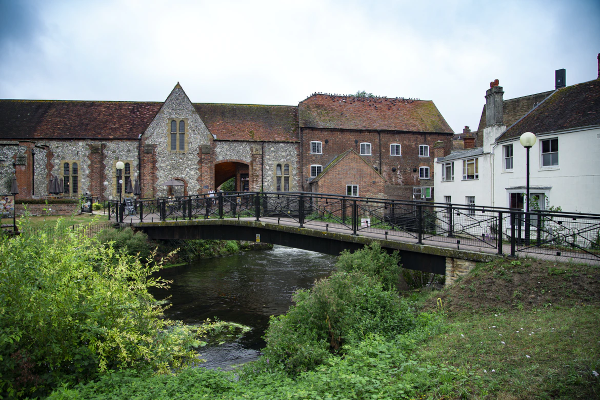
The City of Salisbury is a medium sized town of around 120,000, a regional centre for a mostly agricultural hinterland. Salisbury is an agreeable city with no high rise blocks, the industrial revolution bypassing this particular city. Salisbury Cathedral, the single most popular visitor attraction dominates the skyline.
Salisbury (for England) is a new settlement, only getting started about 800 years ago and grew around Salisbury Cathedral. The original Old Salisbury (where Celts built a classic Iron Age Hill Fort) and the Romans and Normans had settlements is at Old Sarum, up on the hill above modern day Salisbury.
Salisbury - the gateway to Stonehenge
For most people the town is just a pass through on the way to the Cathedral or a place to grab supplies going to nearby attractions like Stonehenge.
Riverside walk in Salisbury
On this page we have written up a short walk route for you, 15 minutes each way, passing through some nice riverside scenery and ending at the attractive Old Mill pub with views of the Cathedral.
Salisbury wool town Shopping/eating in Salisbury Salisbury attractions Salisbury walk from Cathedral to Old Mill
Salisbury as a wool town
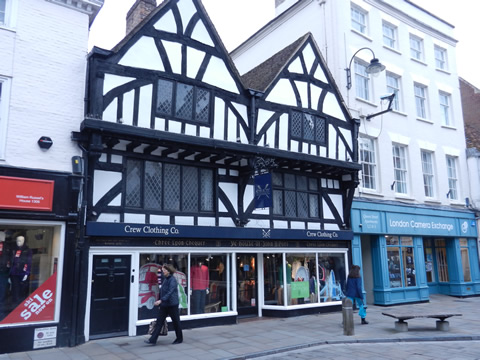
Traditional wooden framed shops in Salisbury
Salisbury had its hey day in the medieval ages when it was a classic wool town, drawing in wool from its hinterland and using its market to sell on to London amongst others.
Many of the wooden buildings from this golden age still populate the core centre of town around the market, which still operates twice a week.
The structure pictured to the left is typical of what you will see in the old centre of the city, a traditional wooden beamed building still used for everyday retail purposes.
Shopping and eating in the High Street of Salisbury
The central shopping centre is immediately accessible through the High Street gate from Salisbury Cathedral.
Apart from the concentration of wooden historic buildings the shops are the same mix of chains and independents you'll find in countless other towns of a similar size in the UK. The centre is very compact reflecting its medieval history and parking is expensive, many use the park and ride schemes on the edge of town.
Because of the influx of visitors there are some tea rooms that otherwise wouldn't be there, particularly on the trek from the coach park to Salisbury Cathedral.
Attractions for the visitor
However, for those who want to explore, the Tourist Centre is in the heart of the town centre and during the summer months, blue badge guides conduct regular walking tours.
There is a theatre too and a full range of restaurants across all budgets, plus a large Sainsbury's supermarket by the coach park. Salisbury Market takes place Tuesday and Saturdays with about 150 stalls.
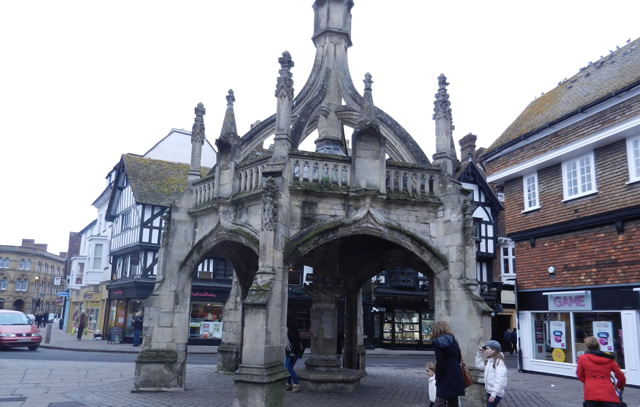
In the very centre you will find the market area, Poultry Cross, pictured left, and the tourist centre. Although there is much of interest for the visitor the town is primarily a regional centre for locals for some distance around. You will find the tourist office here well signposted.
Everything is well signed for the pedestrian. This isn't a place to take a vehicle, leave it in the car park just outside the centre or use one of the park and ride schemes on all major roads into the city.
Salisbury Cathedral to Old Mill Salisbury walk
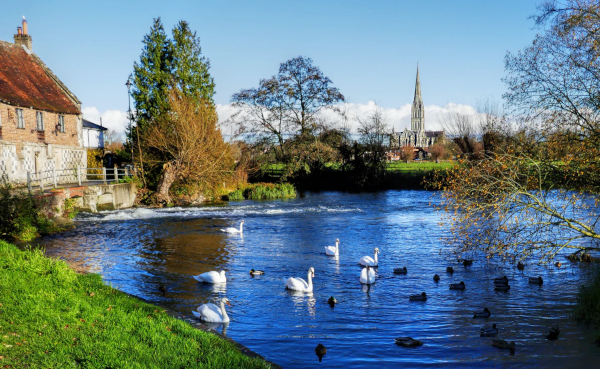
Join us on a short stroll from Salisbury Cathedral to the Old Mill Salisbury, now a hotel and pub. The walk will only take 15 minutes each way tops.
Your destination is a delightful place to take a well earned rest. With a beer garden overlooking the old mill channels and weir. The route goes across the historic water meadows giving another perspective on Salisbury Cathedral.
The Close, Salisbury Cathedral
Your route starts in the Close at Salisbury Cathedral. Make your way through the High Street gate, into the Salisbury city centre, you are now in the heart of the shopping area.
After passing through the arch of the gate, no doubt taking a few photographs you come to a crossroads with traffic lights in around 50 yards.
Crane Street
You turn left here, the road is called Crane Street. This is the dreariest part of the whole walk being along a busy road. Stay on the left hand side of the road. In about 200 yards you cross the River Avon and the perspective brightens up. On your left is a car park and some public toilets, (free and well maintained).
Queen Elizabeth Gardens
Once you pass the car park, there is Queen Elizabeth Gardens on your left. This is a spacious grass area next to the river. On a summer's day there will be a lot of people stretched out on the grass, or feeding the ducks and similar innocent activities. Either follow the road around the border of the park or walk through by the river as it meanders.
At the end of the park you will see a footbridge crossing the river.
Follow Town Path to the Old Mill pub and hotel
Cross over the bridge and follow the path. Be careful as the odds are you will encounter bicycles, but now the traffic is behind us.
You now go on autopilot through the water meadows, the path finishing at the Old Mill (pictured in the left corner of the image above), our destination, right by the River Avon with pleasant views of the Cathedral.
MOST POPULAR TOURS FROM LONDON 2024
VISITING STONEHENGE AND/OR WINDSOR AND/OR BATH
| Stonehenge Morning Half Day Tour - from £65 |
| Windsor Castle Windsor Morning & Afternoon Tours - from £70 |
| Windsor, Bath & Stonehenge (inc Lunch, no adm Roman Baths) - from £99 |
| Windsor, Bath & Stonehenge (no Lunch, inc adm Roman Baths) - from £92 |
| Windsor, Stonehenge & Salisbury - from £85 |
| Windsor & Bath Day Tour - from £85 |
| Windsor, Bath & Stonehenge (Small Group - Max 16 people) - from £156.60 |
| Stonehenge & Bath (Stonehenge admission only) - 3.5 hrs in Bath - from £88 |
| Stonehenge & Bath (Stonehenge & Baths adm) - 3.5 hrs in Bath - from £116 |
| Stonehenge & Bath (Stonehenge & Jane Austen Centre) - 3.5 hrs in Bath - from £118 |
| Stonehenge & Windsor (featuring extended time at Windsor) - from £85 |
| Stonehenge & Avebury - from £114 |
| Windsor, Stonehenge & Oxford - from £79 |
| Stratford, Cotswolds, Bath & Stonehenge - from £128 |
| Stonehenge, Glastonbury & Avebury (Small Group) - from £156.60 |
| Bath, Cotswolds, Stonehenge & Avebury (Small Group) - from £156.60 |
VISITING COTSWOLDS AND/OR OXFORD AND/OR STRATFORD AND/OR WARWICK
| Oxford, Stratford & Warwick Castle - from £74 |
| Oxford, Cotswolds & County pub lunch (Small Group) - from £156.60 |
| Stratford & Cotswolds (inc Anne Hathaway’s) - from £85 |
| Full-day Cotswolds only Tour (Small Group) - from £127 |
| In-depth Cotswolds Only Tour + Lunch - from £127 |
| Blenheim Palace, Downton Abbey Village & Cotswolds Tour - from £72 |
| Stratford, Cotswolds, Bath & Stonehenge - from £128 |
| Windsor, Stonehenge & Oxford - from £79 |
| Oxford & Cambridge Tour (May-Sep only) - from £97 |
| Downton Abbey & Blenheim Palace (Small Group) - £156.60 |
VISITING CANTERBURY, LEEDS CASTLE & DOVER
| Small group Leeds Castle, Dover & Canterbury with river cruise - from £149 |
| Dover Castle, White Cliffs & Canterbury - from £125 |
| Canterbury, Dover & Kent Villages - £139 |
SPECIAL THEME TOURS
| Stonehenge Special Access (Walk Among Stones) Tours |
| Downton Abbey + Highclere Castle Tours |
| Harry Potter Tours |
| London Rock Tour |
DAY TOURS BY TRAIN TO LIVERPOOL, PARIS & SCOTLAND
| Beatles Liverpool Day Tour - £198 |
| Day Trip to Paris - from £259 |
| Day Trip to Edinburgh - from £225 |
2 TO 12 DAY TOURS COVERING GREAT BRITAIN, IRELAND, PARIS & AMSTERDAM
| 2-day Windsor, Stonehenge, Bath & Oxford - from £349 |
| 3-day Stonehenge, Glastonbury, Bath & SW - from £275 |
| 5-day Peak District, Wales & Yorkshire- from £425 |
| 2-day private Stonehenge, Bath, Cotswolds & Oxford - from £650 |
| Budget 3 days in Paris - from £289 (not currently available) |
| Luxury 2 & 3 days in Paris - from £399 (not currently available) |
| 2-day Edinburgh - from £312 |
| 3-day Edinburgh & Scotland Weekend - from £379 (not currently available) |
| 3-day Edinburgh & Scotland Anytime - from £999 |
| 6-12-day tours of Great Britain and Ireland - from £1425 |


