

 Rome Toolkit
  Paris Toolkit
 What is Stonehenge?
Facts and a brief history of Stonehenge for the every day visitor
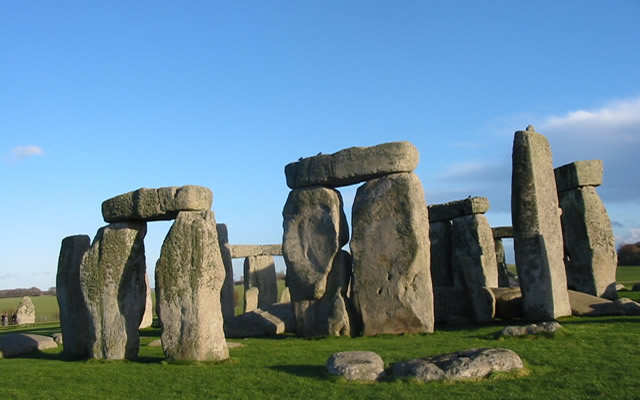
In order to appreciate fully the ancient site that is Stonehenge, a little history helps put it into perspective. There is a risk otherwise, that people may simply view it 'cold', as simply a ring of stones in a barren field in the middle of nowhere.
Those that go there having read a little about our Neolithic ancestors who built it and worshipped there, often come away with their 'experience' of Stonehenge as a memory of their lifetime.
So, this page aims to give you some basic information and facts about the Neolithic people who built Stonehenge, when they built it, and the stones that were used. We have another page, The Mysteries of Stonehenge, that is a natural follow on to this page and covers the theories of what Stonehenge was used for and how it was built.
We think if you read both of these pages prior to your visit to Stonehenge the knowledge will greatly enhance your enjoyment and provide some level of excited anticipation of what you will see on your visit.
Neolithic people The Henge Aubrey Holes Wooden posts at Stonehenge The stones at Stonehenge The Avenue Ley lines What was Stonehenge used for?
Who built Stonehenge? Who were the Neolithic people?
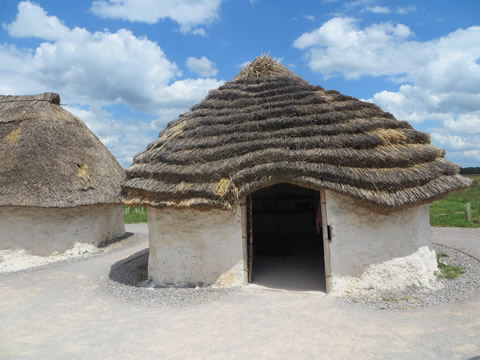
Stonehenge was built by the late Neolithic people around 5000 years ago, about 3000 BC. Pick up a handful of books about Stonehenge and they will probably have differing dates and lengths of time for the same event.
Respected archaeologists revise dates on a fairly regular basis. Every year some respected expert seems to put forward a new theory about Stonehenge that proposes we adjust our existing assumptions. Just treat dates as broadly indicative.
Permanent settlement
It was the emergence of agriculture in the British Isles, which really entirely changed the way of life for Neolithic people, from around 4,000 BC onwards. This meant that for the first time groups were able to have permanent settlements, and as a result, a certain amount of leisure time. At certain times of year there was scope to indulge in activities that went beyond the fundamental task of feeding themselves.
Travel and trade
During the period of building Stonehenge the people underwent a series of transitions themselves, from the Stone Age to the early Bronze Age. People were no longer isolated and static, but outwardly looking, communicating even internationally as they began to travel and trade. Stonehenge may well have developed a reputation as a place of healing, and these early people may well have travelled far and wide to seek its benefits.
Neolithic homes
Archaeological evidence has revealed at the Neolithic homes nearby to Stonehenge, rubbish which all points towards the area being used for feasting and celebration. It is clear to archaeologists that Stonehenge was a large scale operation, involving communication with thousands of different people from all over the country, who would have been involved with its construction. What is truly impressive is that at this time 'technology' was very much in its infancy, metals, nor even the wheel, had been invented.
The Henge - the first stage of development
What is a henge?
A 'Henge' simply refers to a circular or roughly oval shaped ditch, with an external bank. Stonehenge itself is actually an anomaly in that its bank is internal to its ditch, but most theories suggest the design of the six foot high bank would have been to ensure privacy. The only opening was at the main entrance where there is a gap in the ditch.
The 'Henge' part of the structure was Stonehenge's first stage of development; just the circular ditch and bank enclosing the area where ceremonies took place. We cover how these were created and also more about the ceremonies that took place there in our Stonehenge Mysteries page.
When were people building henges?
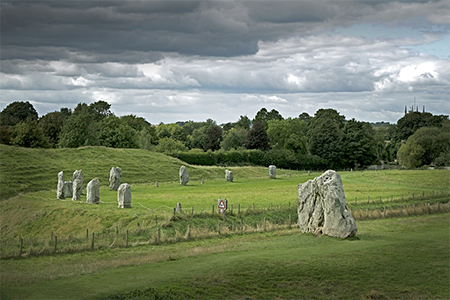
Henges began to be built by the Neolithic people after around 3,000 BC. Henges were built all over the British Isles, today there are around 1,000 henges known of and new ones being uncovered on a regular basis. Examples of some other henges include the nearby Avebury, Knowlton Circles in Dorset and the Ring of Brodgar in Orkney.
Various sizes
Henges vary in size; Avebury is substantially larger than Stonehenge, with dramatically a larger ditches, about 20 feet. The ditches were not defensive, more a device so that people could not see inside to the sacred area where the ceremonies took place. Although similar circles have been found worldwide, none have the same 'unique' structure of the traditional henges of the British Isles.
Stonehenge left untouched
There is evidence to suggest that Stonehenge was left untouched for a long period of time, perhaps a few hundred years. The ditch for example, was allowed to silt up, and at some point was even partially filled in.
Aubrey Holes
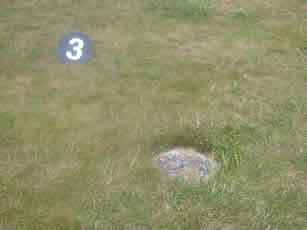
It was during this early phrase in construction that some 56 pits were dug, located just inside the ditch that circles the stones. They would have been about three feet wide and deep at the time. A man named John Aubrey discovered them in the seventeenth century, and they thence became known as "Aubrey Holes". All have been filled in and are painted white.
The one pictured right is sited by point 3 on the audio tour. A lot of conflicting theories abound for their use. Some argue who subscribe to the astronomical importance of Stonehenge that they were used to measure the lunar cycle, which is around 18 solar years. There are broadly 29 days between full moons and 27 days for the moon to complete a cycle orbiting the Earth. (29+27=56).
Fragments of human remains have also been found in these holes as have traces of the Bluestones which maybe suggests that these stones may have at one stage stood in the holes. There is also some debate as to whether these pits ever held wooden posts.
Wooden posts at Stonehenge
Around 2800-2600 BC, it seems that a large number of wooden posts were erected. The arrangement of them has led to many theories as to use; it is possible they may have been markers for alignments for the moonrises. However other thoughts are that they may have been used for forming part of a series of fences, for screening off the central area. What was being hidden (or slowly revealed) from these fences remains a mystery.
The stones at Stonehenge
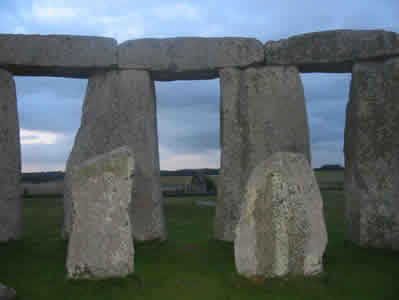
Stonehenge was not built overnight. In fact scholars think the entire site was built over a period of around 1500 years. It is during the period of the late Neolithic, early Bronze Age when the stones finally arrive on the site.
The bluestones
The bluestones, the first stones to arrive at Stonehenge are thought to have been rearranged at least four times within a period about 400 years between 2,400 and 2,000 BC. The first arrangement was thought to be two concentric semi-circles. Bluestone is the common term for Spotted Dolerite—a chemically altered igneous rock.
On our Stonehenge Mysteries page we go into further detail about one of the major mysteries surrounding Stonehenge - just how bluestones got there.
Altar Stone
The Altar Stone is thought to possibly be contemporary with the first arrangement of the bluestones in the semicircle, giving a focal point. This sandstone is much larger than the bluestones, and also probably came on the long journey from Wales, near to Milford Haven on the coast to the south of the Preseli Hills. This is in the centre of Stonehenge lying flat and you cannot see it unless you take a Special Access visit to Stonehenge.
Sarsen stones
It is not until around 2500-2000 BC that the megaliths - the huge sarsen stones - appear. These stones came from the Marlborough Downs, twenty miles north of Stonehenge near Avebury henge. To get an idea of scale, the size of some of the bigger ones is 8ft wide by 5ft thick and 25ft long, and the weight varies from 20 - 50 tons.
When Stonehenge was built there were thirty upright stones, supporting thirty lintels, forming a great circle. Inside this circle were the five pairs of largest sarsens (the Trilithons) arranged in a horseshoe shape.
Today only seventeen uprights still stand, with six lintels. You can still see the horseshoe shaped Trilithons (not all standing), with their open ends facing the entrance to the henge. The horseshoe of stones are not all the same height; they were graduated so that the 'Great Trilithon' at the centre stands at a mighty 24 feet tall. The Altar Stone was thought to have been re-erected within the horseshoe, where it can still be seen today.
The mysteries of how these stones were transported and erected are dealt with in our our Stonehenge Mysteries page.
Station stones
These are smaller sarsen stones, originally four, now only two, though you can see the hollows just inside the ditch where the other two stood. At the time of laying they would have resembled the four corners of a rectangle in layout. Like most things Stonehenge, no firm consensus exists on what their purpose was, although it the alignment of them looks as if they may have been placed for the midsummer sunrise, midwinter sunset and the major northern moonset. These stones were well outside the ring of sarsen stones, about 16 feet inside the henge bank.
Heel Stone & stone alignments
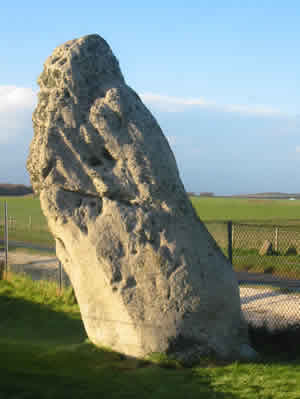
The entrance to Stonehenge is broadly at the north east point of the henge, where it joins with the Avenue. It is at the top of the Avenue where the Heel Stone, is positioned, pictured right.
The heel stone is best understood as one of a missing pair. When built, another stone stood seven feet to the northwest; together they would have been a guide to look through, towards the sunrise of the midsummer sun, as seen from the centre of Stonehenge at the Altar Stone. Today this is a major event and crowds of up to 35,000 come to Stonehenge to experience the summer solstice.
At the midwinter solstice the setting sun sinks between the two uprights of the largest trilithon and behind the altar stone symbolising the death of the year and the birth of a new year ahead. Many academics argue this event is far more important than the summer solstice.
There are many other stellar correlations as well as the sun and moon alignments at Stonehenge. The numbers of stones in some of the stone sets correspond to the numbers of days between a full moon, and the number of years in a lunar cycle and can be used to track the lunar cycle.
Slaughter Stone
The Slaughter Stone is a sarsen stone lying flat with stained red markings caused by rain acting on iron. No evidence of human sacrifice has been uncovered at Stonehenge so its name is perhaps misleading.
It is located just inside the entrance of the henge between the Heel Stone and the Stone Circle. One theory is that this stone is the last remaining of up to three stones that would have been arranged for their own alignments across the entrance.
The Avenue
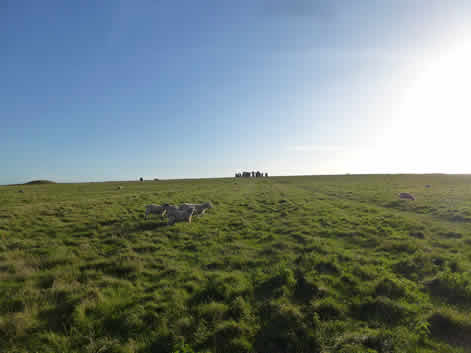
The Stonehenge Avenue is believed to have been built at some time during the phase of construction with the megaliths. It was essentially a long route, used during times of ceremony, starting on the banks of the River Avon, twisting at right-angles twice, and then leading straight up over the brow of the hill towards Stonehenge itself. By revealing Stonehenge slowly, as people walked towards it, it would have given greatest impact to those walking the path.
You can still retrace the steps of the ancestors by doing a walk up the Avenue, towards Stonehenge; Special Access tours will complete the route by allowing you into the circle itself. A rewarding experience in its own right.
Alternatively, when you are at Stonehenge standing by the Heel Stone on the raised walkway if you place your back to the henge, you can just make out the parallel lines of the ditch that marks the edges of the ceremonial route that is the Avenue.
Ley lines
A number of ley lines criss-cross in the centre of Stonehenge. Ley lines are a natural magnetic phenomena that cross the countryside. Ancient monuments often are sited at the intersection of such ley lines.
Even in Saxon times, non pagan churches were built on a ley line. If you see a church aligned say north-south instead of the traditional east-west, the odds are that a ley line runs straight down the aisle.
During your visit to Stonehenge you may be lucky to see someone with dowsing forks tracking the ley lines.
What was Stonehenge used for?
The above paragraphs walk you through what is physically at Stonehenge. Our Stonehenge Mysteries page looks into the theories of what Stonehenge was used for and looks at intriguing mysteries of how the stones were moved to Stonehenge and erected.
MOST POPULAR TOURS FROM LONDON 2024
VISITING STONEHENGE AND/OR WINDSOR AND/OR BATH
| Stonehenge Morning Half Day Tour - from £65 |
| Windsor Castle Windsor Morning & Afternoon Tours - from £70 |
| Windsor, Bath & Stonehenge (inc Lunch, no adm Roman Baths) - from £99 |
| Windsor, Bath & Stonehenge (no Lunch, inc adm Roman Baths) - from £92 |
| Windsor, Stonehenge & Salisbury - from £85 |
| Windsor & Bath Day Tour - from £85 |
| Windsor, Bath & Stonehenge (Small Group - Max 16 people) - from £156.60 |
| Stonehenge & Bath (Stonehenge admission only) - 3.5 hrs in Bath - from £88 |
| Stonehenge & Bath (Stonehenge & Baths adm) - 3.5 hrs in Bath - from £116 |
| Stonehenge & Bath (Stonehenge & Jane Austen Centre) - 3.5 hrs in Bath - from £118 |
| Stonehenge & Windsor (featuring extended time at Windsor) - from £85 |
| Stonehenge & Avebury - from £114 |
| Windsor, Stonehenge & Oxford - from £79 |
| Stratford, Cotswolds, Bath & Stonehenge - from £128 |
| Stonehenge, Glastonbury & Avebury (Small Group) - from £156.60 |
| Bath, Cotswolds, Stonehenge & Avebury (Small Group) - from £156.60 |
VISITING COTSWOLDS AND/OR OXFORD AND/OR STRATFORD AND/OR WARWICK
| Oxford, Stratford & Warwick Castle - from £74 |
| Oxford, Cotswolds & County pub lunch (Small Group) - from £156.60 |
| Stratford & Cotswolds (inc Anne Hathaway’s) - from £85 |
| Full-day Cotswolds only Tour (Small Group) - from £127 |
| In-depth Cotswolds Only Tour + Lunch - from £127 |
| Blenheim Palace, Downton Abbey Village & Cotswolds Tour - from £72 |
| Stratford, Cotswolds, Bath & Stonehenge - from £128 |
| Windsor, Stonehenge & Oxford - from £79 |
| Oxford & Cambridge Tour (May-Sep only) - from £97 |
| Downton Abbey & Blenheim Palace (Small Group) - £156.60 |
VISITING CANTERBURY, LEEDS CASTLE & DOVER
| Small group Leeds Castle, Dover & Canterbury with river cruise - from £149 |
| Dover Castle, White Cliffs & Canterbury - from £125 |
| Canterbury, Dover & Kent Villages - £139 |
SPECIAL THEME TOURS
| Stonehenge Special Access (Walk Among Stones) Tours |
| Downton Abbey + Highclere Castle Tours |
| Harry Potter Tours |
| London Rock Tour |
DAY TOURS BY TRAIN TO LIVERPOOL, PARIS & SCOTLAND
| Beatles Liverpool Day Tour - £198 |
| Day Trip to Paris - from £259 |
| Day Trip to Edinburgh - from £225 |
2 TO 12 DAY TOURS COVERING GREAT BRITAIN, IRELAND, PARIS & AMSTERDAM
| 2-day Windsor, Stonehenge, Bath & Oxford - from £349 |
| 3-day Stonehenge, Glastonbury, Bath & SW - from £275 |
| 5-day Peak District, Wales & Yorkshire- from £425 |
| 2-day private Stonehenge, Bath, Cotswolds & Oxford - from £650 |
| Budget 3 days in Paris - from £289 (not currently available) |
| Luxury 2 & 3 days in Paris - from £399 (not currently available) |
| 2-day Edinburgh - from £312 |
| 3-day Edinburgh & Scotland Weekend - from £379 (not currently available) |
| 3-day Edinburgh & Scotland Anytime - from £999 |
| 6-12-day tours of Great Britain and Ireland - from £1425 |


